
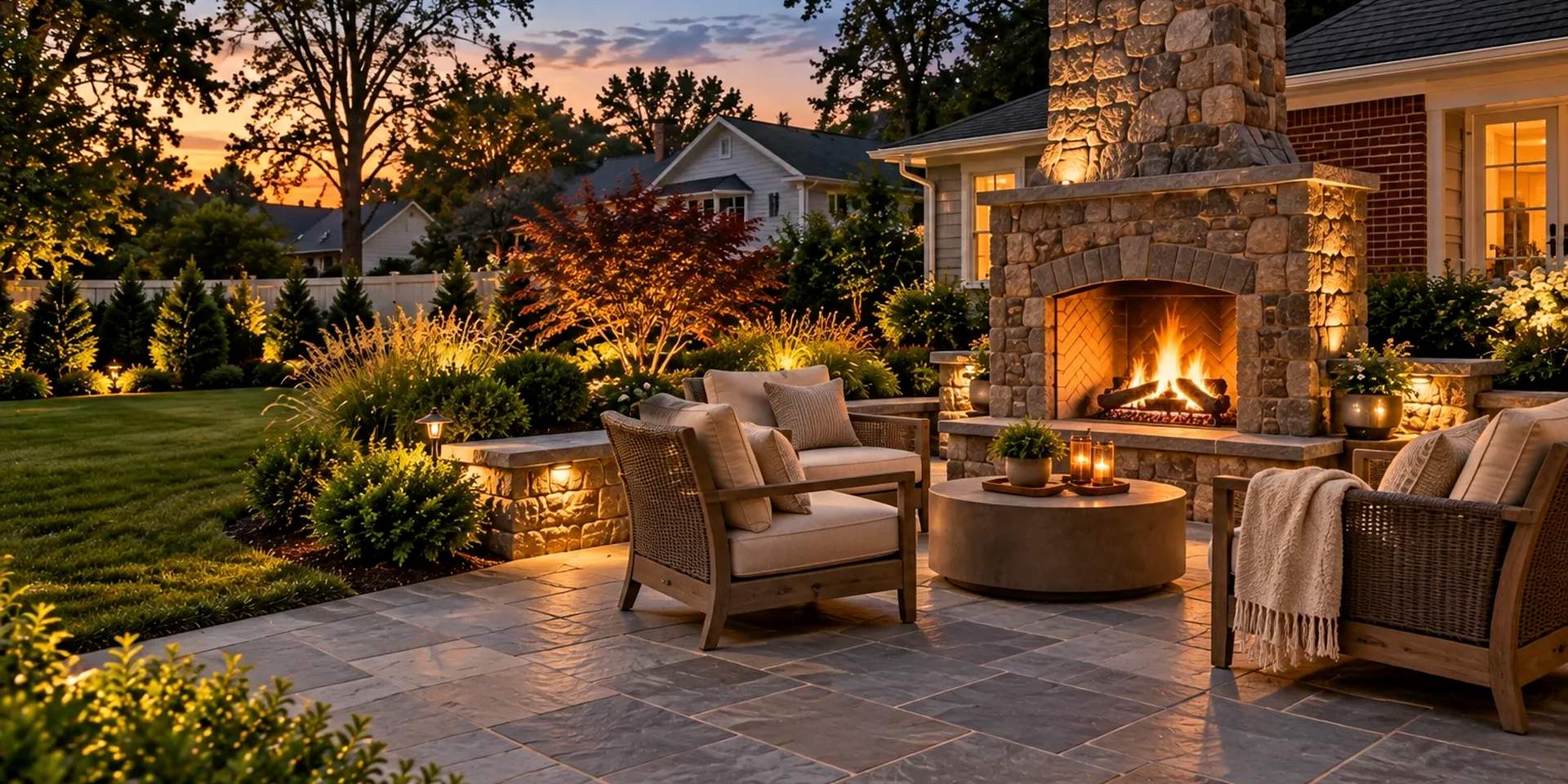
Outdoor fireplaces & fire features
Outdoor Fireplaces and Fire Features in Monmouth County, NJ
Fire changes how a backyard gets used. It pulls people outside earlier in the spring, keeps them there later into the fall, and gives every gathering a natural center. True North designs and builds outdoor fireplaces and fire pits together with the patio and seating around them, so the fire, the layout, and the rest of the space work as one.
Fireplace or Fire Pit?
Both bring people together, but they shape a space in very different ways.
Outdoor fireplace
- Feel
- An architectural focal point, like an outdoor living room
- Seating
- Arranged facing the fire
- Presence
- Tall, defines the space, can screen a view or add privacy
- Best for
- Main patios and outdoor rooms that need a focal point, often near a kitchen or dining area
Fire pit
- Feel
- Casual and social, with seating all the way around
- Seating
- A circle or partial circle
- Presence
- Low profile that keeps views open
- Best for
- Open terraces, lawn-edge gathering spots, lower levels of the yard
When a fireplace makes sense
An outdoor fireplace gives a patio structure. It anchors a seating area, sets the scale of the space, and draws smoke up and away from guests through its chimney. On properties where a patio feels exposed, a fireplace can also block an unwanted view or create a sense of enclosure.
When a fire pit makes sense
A fire pit is about conversation. Everyone faces the fire and each other, and the low profile keeps sightlines open to the yard and the view beyond. Fire pits also fit naturally on lower terraces and at the edges of a lawn.

Some larger properties include both: a fireplace anchoring the main patio near the kitchen, and a fire pit on a lower terrace for a different kind of evening.
Wood-Burning or Gas
Wood-burning fire features deliver the real thing: crackle, aroma, and a fire you tend. They need a place to store dry wood, and smoke and local burning rules factor into where they're placed.
Gas fire features light at the turn of a switch or a key, burn cleanly, and shut off when the evening ends, which suits homeowners who use the space often or want a fire with minimal effort. They need a gas supply, which is connected by appropriately licensed professionals and permitted as your town requires.
The right choice depends on how often you'll use it, the experience you want, and the site itself.
Designing the Seating Around the Fire
A fire feature is only as good as the space around it. The details that make the biggest difference are the ones people notice only when they're missing.
- Comfortable distance. Seating close enough to feel the warmth, but not so close that it gets uncomfortable.
- Room to move. A clear path around the seating, so no one has to squeeze past the fire.
- Built-in or movable seating. Seat walls create a permanent, finished edge, while furniture keeps the layout flexible. Many spaces use both.
- Orientation. Placement that considers prevailing winds, the views you want to face, and the sightline from inside the house.
- Light for the way back. Path and step lighting so guests can move safely after dark.
Built Into the Hardscape
A True North fire feature is part of the hardscape, not an accessory set on top of it. Its materials are chosen to complement the patio, walls, and home, and its surround, cap, and hearth details are designed so it looks like it was always meant to be there.
Outdoor fireplaces in particular are heavy structures that need a solid foundation of their own, built with the same care as the patio around them. Fire-rated materials are used where the heat demands them. Placement accounts for clearance from the house, trees, and any roof, pergola, or overhang, along with ventilation and local requirements. Not every location is suitable for a fire feature, and that's settled during design, before anything is built.
The Center of a Complete Outdoor Living Space
Fire features are at their best as part of a larger plan.

- Patios. The patio sets the room for seating, circulation, and the fire itself. Explore paver patios and walkways.
- Outdoor kitchens. A fireplace or fire pit near the kitchen keeps guests gathered while the cook finishes. Explore custom outdoor kitchens.
- Retaining and seat walls. On sloped lots, a wall can create the level terrace for a fire pit and double as seating. Explore retaining wall construction.
- Lighting and plantings. Soft lighting and layered plantings set the mood and frame the space. See how they fit into landscape design and installation.
Fire Features for Monmouth County Evenings
Here, a well-placed fire feature adds weeks to the outdoor season on both ends of the year. Near the rivers and the bay, steady breezes affect how smoke travels and how a gas flame behaves, so placement and screening matter. On wooded lots, clearance from overhanging branches comes first. Rules for open burning and fire features vary by town, so they're reviewed as part of planning. We design and build fire features throughout our Monmouth County service area.
How a Fire Feature Project Comes Together
- Design consultation. We talk through how you'll use the space, walk the property, and look at placement, views, and wind.
- Layout and style. We define the type of fire feature, fuel, seating, and materials, and how it connects to the patio and the rest of the yard.
- Project estimate. Once the design is defined, we prepare an estimate for the work.
- Site preparation and foundation. The area is excavated and the base is built, with any utility routes in place before surfaces go in.
- Construction and walkthrough. The fire feature and surrounding hardscape are built and finished, and we walk the completed space with you.
Fire Feature FAQs
Are fire pits and outdoor fireplaces allowed in my town?
In most Monmouth County towns they are, but local rules on open burning, setbacks, and gas connections vary. Wood-burning features tend to have more restrictions than gas, so it's worth checking requirements early in the design.
How far should a fire feature be from the house?
Far enough to meet local requirements and any manufacturer guidance, and clear of low overhangs, covered structures, and trees. Placement also has to work for smoke, wind, and the flow of the patio.
Can a fire feature be added to an existing patio?
Often, yes. It depends on the patio's condition, its base, the available space, and, for gas, how a supply line can reach the location. Sometimes a fire pit on a new adjoining terrace works better than fitting one into an existing patio.
Does an outdoor fireplace need a chimney?
A wood-burning outdoor fireplace typically includes a chimney to draw smoke up and away from the seating area. Gas units vary, and their venting follows the manufacturer's requirements.
Images on this page are AI-generated illustrations of design ideas. They are not photographs of completed True North projects.
Reviews
Proof From Local Homeowners
Reviews help homeowners understand what it’s like to trust True North with a full design-build project.
Ready to extend your evenings outside?
Let's Design a Space Worth Gathering Around
Tell us how you want to spend evenings outside, and we'll help you plan a fire feature and the space around it.